
Winter Garage Door Maintenance Checklist (Ottawa & Eastern Ontario)
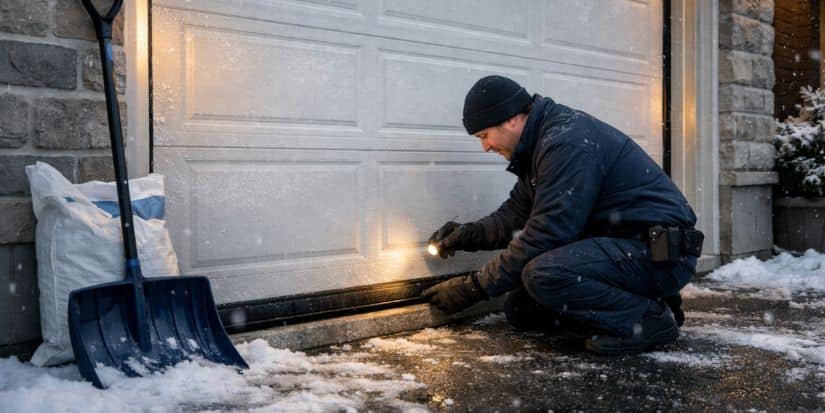
Ottawa winters bring freezing temperatures, ice storms, salt, and constant freeze/thaw cycles. That combination is hard on garage door weather seals, rollers, springs, and even your garage door opener. Use this winter maintenance checklist to reduce breakdowns, prevent the door from freezing shut, and keep your garage warmer.
Table of Contents
1) Snow + ice prevention (do this weekly in winter)
Clear the bottom seal area before opening the door (packed snow can bind the seal).
Remove ice at the floor line if the door is frozen:
Use a plastic shovel or ice scraper (avoid metal that can tear the seal).
If needed, gently tap ice along the bottom edge to release it.
Never keep pressing the remote when the opener hums but the door won’t move—this can strip gears or burn the motor.
Watch for drainage issues: meltwater refreezing at the threshold is a common Ottawa problem.
2) Safety test: auto-reverse + photo-eye sensors (monthly)
Photo-eye sensor check
Wipe both sensor lenses (salt spray and dust can block the beam).
Confirm alignment: most sensors show a steady light when aligned properly.
Make sure the wiring isn’t loose or damaged.
Auto-reverse “2×4 test”
Place a 2×4 flat on the floor under the center of the door.
Close the door: it should reverse when it contacts the board.
If it doesn’t reverse, stop using the door and book service.
3) Lubrication points (every 6–8 weeks in winter)
Use garage door lubricant or silicone-based lube (not WD-40 as a long-term lubricant).
Lubricate:
Hinge pivot points
Roller bearings (if not sealed rollers)
Torsion spring coils (light coat to reduce noise + corrosion)
End bearing plates / center bearing
Opener rail (chain/belt) only if your manufacturer recommends it
Do NOT lubricate the tracks. Tracks should stay clean and dry.
4) Hardware + wear inspection (monthly)
Look for early warning signs before they become emergency failures:
Cables: fraying, rust, or strands separating (high risk—do not touch).
Rollers: cracked nylon, wobbling, seized bearings.
Hinges: bent hinges, missing bolts, rust-through.
Track: dents, gaps at joints, shifted brackets.
Fasteners: loose lag bolts on the track and opener mounting.
If you see cable damage, stop using the door and call a professional. Cables and springs are under dangerous tension.
5) Door balance test (biggest “preventer” for opener strain)
A door that’s out of balance is the #1 reason openers struggle (especially in cold weather).
How to test:
Close the door fully.
Pull the emergency release to disconnect the opener.
Lift the door to about waist height and carefully let go.
What it means:
Stays in place: balance is good
Drops quickly: spring tension may be weak
Shoots up: spring may be over-tensioned
Feels heavy: springs may be failing
If the door feels heavy, don’t keep running the opener—book service.
6) Weatherproofing checklist (keeps your garage warmer)
Ottawa drafts usually come from three areas:
Bottom seal: cracking, missing sections, hardened rubber, light showing under the door.
Side seals / top stop seal: daylight lines around the frame.
Panel insulation / perimeter gaps: cold air leaks and condensation inside.
If your garage is colder than normal, damaged weatherstripping is often the culprit—not the opener.
7) Opener care (winter reliability)
Replace remote/keypad batteries (cold reduces battery performance).
Watch for slow opening or repeated stops—often a sign of friction, poor balance, or a failing part.
If your opener is older and parts are discontinued, consider proactive replacement before peak winter issues.
8) When to call a professional (don’t DIY these)
Call for service if you notice:
- The door is crooked, jerky, or shakes
- A loud bang (possible spring break)
- Frayed cables or loose cable drums
- Door won’t stay open / feels too heavy
- Opener strains, hums, or reverses randomly
- Track is bent or rollers jump the track